 how-to
Signs You Need Pipe Replacement: 7 Warning Signs
Table of Contents
- Signs You Need Pipe Replacement: 7 Warning Signs
- Average Life Expectancy of Plumbing Pipes by Material
- Cost to Replace Cast Iron Pipes in 2026
- Repair vs. Repipe: How to Decide
- DIY Pipe Inspection Checklist
- What Homeowners Insurance Covers for Pipe Replacement
- When to Call a Licensed Plumber
- Frequently Asked Questions
Last Updated: September 14, 2026
Signs You Need Pipe Replacement: 7 Warning Signs
Most homeowners think about pipe replacement only when water pools in the basement, the expensive way to learn. Knowing the warning signs lets you plan the work on your schedule, not during a 2 AM emergency.
Here are the seven signs that matter most.
- Frequent or persistent leaks. One repair is normal. Three in a year means the pipe is telling you something.
- Discolored or rusty water. Brown or yellow water at the tap points to internal corrosion, especially in older homes.
- Low water pressure. A drop across multiple fixtures usually means mineral buildup or a hidden leak.
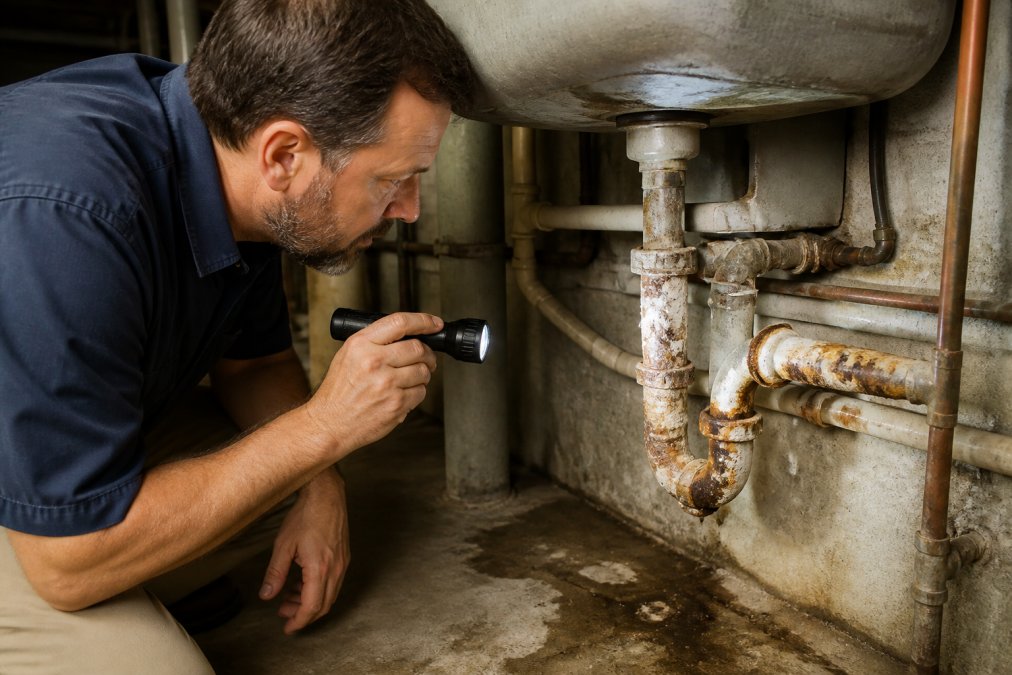
- Visible cracks or corrosion on pipes. Flaking metal, white crust, or pitting you can see is pitting you cannot ignore.
- Unpleasant taste or smell. Metallic or sulfur-like water often traces back to the pipes themselves.
- Age of the plumbing system. Galvanized steel and cast iron have known service windows, and most homes built before 1980 are past them (hud.gov).
- Structural damage. Peeling paint or wallpaper, warped baseboards, or soft drywall often mean moisture behind the wall.
How to Tell If Pipes Are Leaking Behind Walls
You cannot see behind drywall, but the house tells you anyway. The most reliable indicators are a water meter that keeps spinning with every fixture off, unexplained bill spikes, and warm or damp patches on walls and floors. Musty odors with no obvious source are another clue.
A licensed plumber confirms the location with leak detection equipment and video pipe inspection before opening anything up, cutting into drywall to hunt for a leak costs far more than the diagnostic.
Average Life Expectancy of Plumbing Pipes by Material
Pipe lifespan depends almost entirely on material. The table below shows typical service windows and the failure mode that ends each one. Treat these as benchmarks, not guarantees, water chemistry, pressure, and installation quality move the number both ways.
| Material | Typical Lifespan | Common Failure Mode | How It Fails |
|---|---|---|---|
| Galvanized steel | 40-50 years | Internal corrosion, mineral buildup | Rust narrows the bore from the inside; pressure drops before it leaks |
| Copper | 50-70 years | Pinhole leaks, joint failure | Thin-wall pitting and solder joint fatigue; leaks start small |
| Cast iron | 50-75 years | Corrosion, cracking, root intrusion | Scale and rust flake off; roots find every joint gap |
| PEX | 50+ years | Fitting failure | The pipe outlasts the fittings; failures cluster at connections |
| PVC | 50+ years | Joint separation, UV degradation | Solvent-weld joints fail first; sunlight embrittles exposed runs |
Why the Failure Mode Matters More Than the Number
The lifespan number tells you when to start paying attention; the failure mode tells you what to look for. Galvanized steel and cast iron fail from the inside out, so damage is often invisible until it is not, by the time you see rust outside, the wall thickness is gone. Copper pinhole leaks weep for months before showing as a stain. PEX and PVC rarely fail in the pipe body; they fail at the joints, so a fitting leak on a 20-year-old PEX system does not mean the whole system is done.
How to Identify What You Have
You do not need to cut into a wall to get a good guess. A few visible clues usually settle it:
- Galvanized steel looks dull gray and is magnetic. Scratch it and the surface is silver under the coating.
- Copper is reddish-brown and non-magnetic. Green or white crust at joints is a corrosion sign.
- Cast iron is dark, heavy, and magnetic. It is almost always drain line, not supply.
- PEX is flexible, comes in red, blue, or white, and is usually stamped with the manufacturer and a date.
- PVC is white or gray rigid plastic, used for drains and sometimes supply in newer builds.
If you cannot tell, the home's age is a strong proxy. Most homes built before 1980 still have galvanized supply lines or cast iron drains, both past their expected service life. Homes from the 1980s and 1990s are typically copper; homes after 2000 are increasingly PEX.
What Shortens the Clock
Lifespan is a range, not a fixed date. Several factors push a system toward the low end:
- Aggressive water chemistry. Low pH or high chloride accelerates copper pitting and galvanized corrosion.
- High water pressure. Sustained pressure above the typical residential range stresses joints and fittings across every material.
- Hard water. Mineral scale builds up faster in galvanized and copper, narrowing the bore and reducing flow.
- Poor installation. Sharp bends, mismatched fittings, and improper support create stress points that fail early.
- Freeze events. A single hard freeze can split copper and crack PVC, resetting the clock on that section.
What This Means for Your Decision
If your home is past the low end of its material's range and you see two or more warning signs above, you are not dealing with a one-off repair, you are dealing with a system that is due. That is when a planned repipe beats a series of emergency repairs, and when a camera inspection is worth the cost.
Cost to Replace Cast Iron Pipes in 2026
The cost to replace cast iron pipes in 2026 depends on how much pipe is accessible, how much runs under slab or through finished walls, and whether floors must be opened. A single accessible section costs far less than a whole-house repipe, and that gap is where most budget surprises come from.
Metro Repair Plumber provides a written quote before any work begins, so you know the full scope and price up front rather than discovering it mid-project. Current pricing is listed on our website.
One thing worth knowing: cast iron fails slowly, then all at once. Corrosion narrows the pipe from the inside and root intrusion finds every gap. By the time you face repeat backups, hydro-jetting only buys time, it does not restore the pipe.
Repair vs. Repipe: How to Decide
The decision is not about how bad today's problem is, but how much of the system is already compromised. A single failed section in otherwise healthy pipe is a repair; widespread corrosion, repeated failures in a short window, or a material past its service life points to a repipe.
A simple three-question framework can help:
- How old is the system? If it is past its material lifespan, repairs are temporary by definition. Patching a 60-year-old galvanized line is buying months, not years.
- How many failures in the last two years? Three or more separate leaks usually means the pipe is done. The fourth leak is not a coincidence; it is a pattern.
- What is the material? Galvanized steel and cast iron rarely justify repeated patching. Copper and PEX often do, because a single failure in an otherwise sound system is genuinely isolated.
When a Repair Is a Band-Aid
A repair is a band-aid when the failure comes from system-wide deterioration, not a localized defect. Three signals tell you which you are looking at:
- The failure is internal. Pitting, tuberculation, and mineral scale form along the whole run, not just at the leak. If the inside of one section is rough, the rest is too.
- The pipe material is past its window. A 55-year-old galvanized supply line is not failing because of one bad joint. It is failing because the wall thickness is gone.
- The failures are moving. If the first leak was under the kitchen and the second is in the bathroom, the problem is traveling through the system, not sitting in one spot.
A band-aid repair is not wasted money, it buys time to plan and budget a repipe on your schedule instead of an emergency one. What it is not is a permanent fix.
When a Repipe Is the Right Call
A repipe makes sense when repeated repairs, water damage risk, and lost time exceed the cost of doing the work once. A common pattern: a homeowner approves three repairs over two years, then a slab leak or ceiling collapse forces the repipe anyway, plus the damage.
Add the invoices: three service calls, drywall patching, the water bill from a hidden leak, and the deductible and premium impact from a claim often land close to or above a planned repipe, which comes with a warranty and none of the water damage risk in between.
What Changes the Scope and Cost
The difference between a small repair and a whole-house repipe is not the number of pipes, it is access. A single accessible section under a sink is straightforward; a repipe under a slab, through finished walls, or behind tile requires opening floors and walls, where most of the cost and disruption lives.
Ask any contractor to separate the quote into three lines: pipe and fittings, labor, and restoration (drywall, flooring, paint). That breakdown lets you compare a repair quote against a repipe quote honestly, instead of a patch against a project.
The Decision in One Line
If the system is young and the failure isolated, repair it. If it is past its material lifespan, failures are multiplying, or damage is internal and widespread, repipe it. Anything in between is a judgment call best made after a camera inspection, not a sales pitch.
DIY Pipe Inspection Checklist
You can catch most early warning signs yourself in about 20 minutes. Work through this list once a season:
- Check under every sink for moisture, staining, or soft cabinet floors
- Look at exposed pipes in the basement or crawlspace for rust, white crust, or flaking
- Run two fixtures at once and compare water pressure
- Fill a clear glass and hold it to the light to check for discoloration
- Smell the water at each tap for metallic or sulfur odors
- Inspect walls and ceilings for new stains, bubbling paint, or warping
- Check the water meter overnight with all fixtures off
- Note the age of your home and the pipe material if visible
Anything that shows up on this list is worth a professional look, not necessarily a replacement.
What Homeowners Insurance Covers for Pipe Replacement
Homeowners insurance generally covers the water damage a burst pipe causes, not the pipe replacement itself. The ruined drywall, flooring, and belongings may be covered; the failing pipe usually is not, because wear and tear and gradual deterioration are standard exclusions.
Two things follow from that. First, document everything with photos before cleanup begins. Second, ask your insurer directly whether your policy includes any coverage for the pipe itself, since terms vary. The Texas Department of Insurance homeowner policy guide explains how standard exclusions work and what questions to ask your carrier.
A proactive repipe is almost always cheaper than a burst pipe plus an insurance claim plus a premium increase.
When to Call a Licensed Plumber
Call a licensed plumber when you see multiple warning signs at once, when water is actively escaping, or when you cannot locate the source of a leak. A licensed plumber is required for most residential plumbing work, and the license is verifiable through the state board.
Metro Repair Plumber technicians are licensed, insured, and background-checked. We provide a written quote before work begins, with no hidden fees, and we protect your floors and leave your home cleaner than we found it.
Pipe failure rarely announces itself politely. It drips, discolors, and backs up until the day it floods a room. If you have spotted two or more warning signs above, get an inspection before the decision is made for you. Metro Repair Plumber offers written quotes before any work begins, licensed and background-checked technicians, and a satisfaction guarantee backed by a promise to make things right. Chat with us to schedule your inspection and get a straight answer on whether you need a repair or a full pipe replacement.
Frequently Asked Questions
How do you know if pipes need to be replaced?
Watch for discolored or rusty water, low water pressure, frequent leaks, and unpleasant tastes or smells. Visible corrosion, peeling paint on walls, and repeated clogged drains also point to pipe failure. If your home has galvanized steel or cast iron pipes over 40 years old, and you are seeing two or more of these signs, a plumbing inspection with video camera equipment can confirm whether pipe replacement is the right call.
Does homeowners insurance cover replacing plumbing pipes?
Most policies cover sudden, accidental damage like a burst pipe, but they typically exclude the cost of the pipe replacement itself and damage from gradual wear, corrosion, or poor maintenance. If a slow leak has been developing for months, expect a denial. Review your policy language and document the damage with photos before filing. A licensed plumber can provide a written report that separates the sudden failure from long-term corrosion, which may help your claim.
What is the average life expectancy of house plumbing pipes?
Galvanized steel lasts 40 to 50 years, cast iron 50 to 75 years, copper 50 to 70 years, and PEX 40 to 50 years. Brass and PVC vary widely depending on water chemistry and installation quality. Homes built before 1980 often still have original galvanized or cast iron lines that are at or past these benchmarks. If your plumbing system is approaching or past its expected lifespan, schedule an inspection before a pipe burst forces an emergency call.
What are the signs your sewer line is broken?
Four clear signs: sewage backing up into multiple drains at once, gurgling sounds from toilets after running a sink, soggy patches or unusually green grass in the yard, and a persistent sulfur smell near the foundation. Root intrusion, shifting soil, and aging cast iron are the usual causes. A video pipe inspection confirms the break and its location. Sewer line repairs are not a DIY job and usually need hydro-jetting or full replacement of the damaged section.